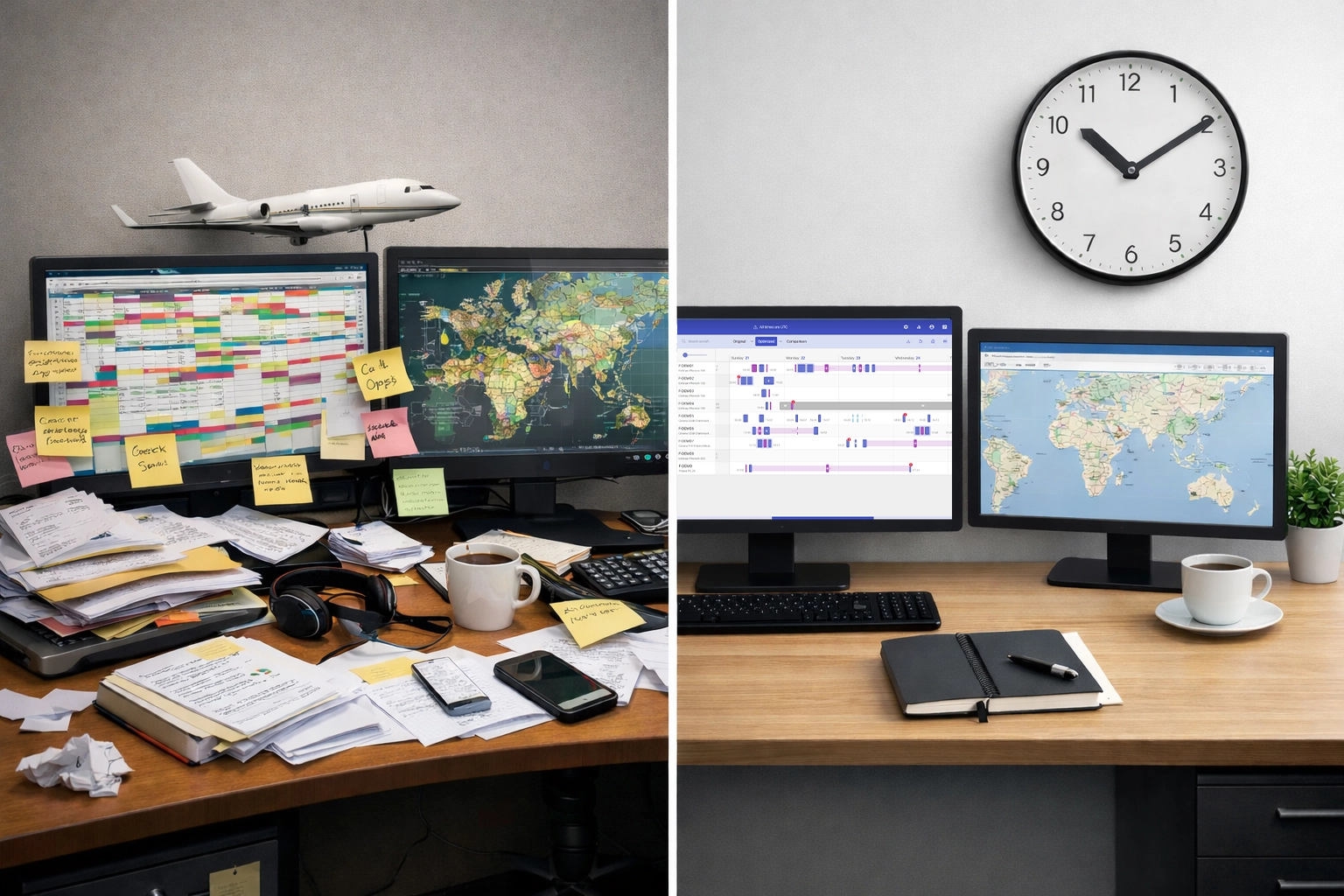
Optimization of the Planner's Day: The Unexpected Leverage of OPTIRISE

Beyond Optimization
Operators typically adopt OPTIRISE™ to address clear, quantifiable challenges: unnecessary positioning flights, suboptimal utilization, and avoidable CO₂ output. These improvements appear early and are easy to measure. But once OPTIRISE™ becomes embedded in day-to-day operations, a secondary effect emerges, one that is less visible in dashboards but highly tangible in the workflow.
Scheduling stops consuming disproportionate attention. The constant adjustments, rule checks, and manual recalculations reduce significantly. The operational day becomes more structured, more predictable, and less reactive.
The Return of Time
This is the benefit operators rarely anticipate at the start. One client described it simply:
"OPTIRISE™ saves me a good half day per week."
The value lies not only in reclaimed hours but in the removal of continuous operational pressure. With manual scheduling no longer dominating their bandwidth, teams gain margin, the capacity to handle tasks that genuinely influence performance. Planners can begin their NOTAM and airspace reviews earlier, improving foresight. Dispatch can analyze slot constraints and operational risks with more accuracy. Client teams can prepare clearer briefings and communicate earlier with crews, strengthening the overall customer experience. The workflow does not change through a formal process shift, it changes because the constraint that shaped the day disappears.
The Impact That Follows
Once scheduling stops dictating the tempo, the entire operation benefits from increased stability. Coordination between sales, dispatch, and scheduling becomes smoother. Task handovers are cleaner and less time-sensitive. Decisions are taken with more lead time and better situational awareness.
Although OPTIRISE™ is positioned primarily as a fleet optimization engine, this restored operational margin amplifies every other metric. Better planning contributes to fewer unnecessary flights. Earlier communication improves service quality. Stronger cross-team cohesion reduces the friction that rarely appears in official reporting but significantly affects performance.
Operational optimization, "the optimization of the day itself" is the outcome our users call the real differentiator.
Related Articles

Rising Jet Fuel Prices: Why Every Non-Revenue Leg Matters More
Rising jet fuel costs change the economics of every request, aircraft assignment and positioning flight. Here is what operators can control.
Read more
Your Fleet Should Not Depend on One Person
Flight departments often run smoothly until the one person everyone relies on is unavailable. That dependency is structural — and costly.
Read more
The Hidden Planning Pressure in Multi-Aircraft Operations
In multi-aircraft operations, the coordination effort required to keep schedules stable is invisible — but its financial consequences are not.
Read more