Rising Jet Fuel Prices: Why Every Non-Revenue Leg Matters More

A conflict thousands of miles away can show up quickly in a fuel invoice.
Across business aviation, rising jet fuel costs are prompting operators to review charter rates, fuel surcharges, and flight department budgets. The pressure reaches beyond the fuel bill: it changes the economics of each request, each aircraft assignment, and each positioning flight.
Positioning an aircraft for pickup, repositioning after drop off, and preparing for its next commitment all influence the cost of delivering a trip. As fuel becomes more expensive, those connections deserve closer attention.
How global disruptions reach the fuel bill
Today's pressure reflects overlapping disruptions to energy supplies, refining capacity, and transport.
The war involving Iran has disrupted Middle East supplies and shipping through the Strait of Hormuz. Europe has been particularly exposed. In September, Reuters reported that the conflict had interrupted around half of Europe's jet fuel imports, forcing buyers to seek replacement supplies from countries including the United States, Canada, Nigeria, and South Korea. Analysts still forecast a European supply deficit for the fourth quarter.
Meanwhile, Ukrainian attacks on Russian refineries have reduced another major source of refined fuels in the overall market. According to the International Energy Agency, strikes have damaged processing units that help produce diesel and jet fuel. Serious damage to these complex units can take months to repair, while sanctions complicate access to replacement equipment. Russia has also restricted fuel exports to protect domestic supplies.
These pressures interact. When supplies from one region fall, buyers compete for alternatives elsewhere. US production therefore does not isolate domestic operators from global conditions: overseas demand can draw on US supplies and reshape international trade flows.
The impact has also been visible in the US market. According to the US Energy Information Administration, Gulf Coast jet fuel spot prices averaged $3.91 per gallon from March through May 2026, approximately twice their level at the start of the year. US refiners increased jet fuel production, while stronger overseas demand drove exports to record levels in April and May. These wholesale figures are different from FBO prices, but they show how international disruptions can reach domestic fuel costs.
A regional supply deficit does not mean every airport will run out of fuel. It does make it more important to check local availability and pricing rather than assume yesterday's conditions will hold.
Why crude oil prices tell only part of the story
Jet fuel prices reflect more than the cost of crude oil. Aviation needs a finished product that meets strict specifications, produced by refineries and delivered through a specialized supply chain.
Jet fuel also shares its production system with other essential fuels. Alongside diesel and heating oil, it belongs to the middle distillate family, produced from related boiling ranges during refining. Although these products have different specifications, pressure on one market can affect the others.
IATA highlights diesel's importance to refinery profitability: disruptions in diesel markets can have a disproportionate effect on jet fuel availability and pricing. Aviation can therefore face higher fuel costs even when the underlying disruption originates outside its own industry.
Seasonal demand adds another consideration. Elevate Jet founder and CEO Greg Raiff has highlighted the potential for winter heating oil demand to compete with aviation for refinery output if capacity disruptions persist. This is a risk when supplies are constrained, rather than an inevitable shortage.
Refinery configuration matters too. Plants differ in the balance of products they can produce, with some favoring gasoline and others supporting greater middle distillate output. In the United States, gasoline represents the largest share of refinery production. Refiners can adjust their product mix, but equipment, crude oil grades, and the cost of modifying infrastructure limit that flexibility. More crude oil, or spare gasoline supply, does not automatically translate into more jet fuel.
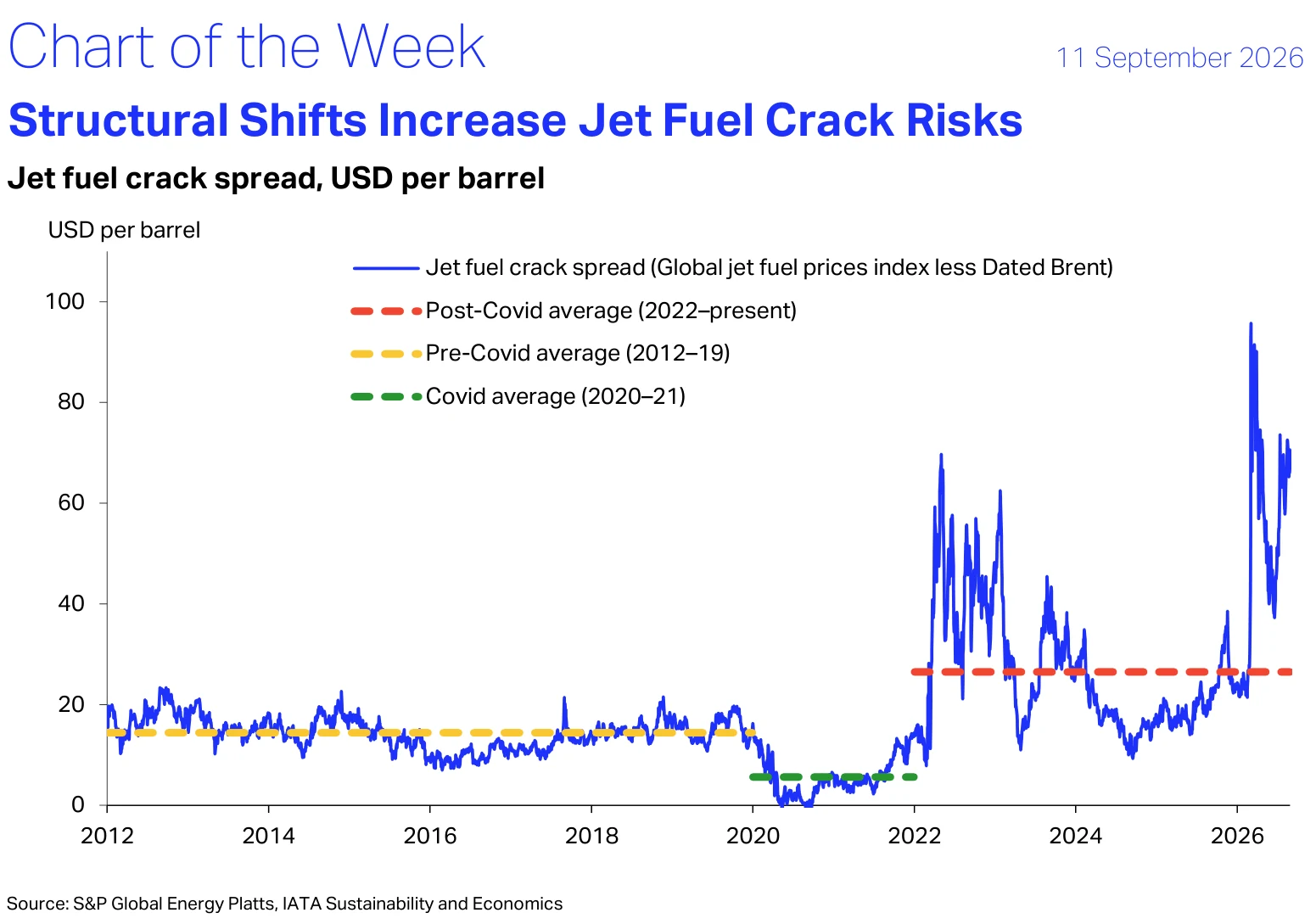
When refining capacity or finished fuel supplies become constrained, jet fuel can become more expensive relative to crude. That difference is known as the jet fuel crack spread.
IATA's September 2026 analysis clearly shows a significant increase in the crack spread since the start of the Iran war, hovering around the $60 mark, almost twice the post-2022 average, with greater volatility. The graph below compares a global jet fuel price index with Dated Brent, illustrating why crude oil alone is an incomplete guide to aviation fuel costs.
At the FBO, local supply arrangements, taxes, fees, and negotiated discounts further influence the final bill. Operators need to consider the fuel prices available to their operation at the airports their missions require.
What higher fuel costs change for operators
The implications reach across charter businesses, fractional programs, and corporate flight departments, although their exposure differs.
For charter operators, including those operating under Part 135 in the US, a price increase between quoting and departure can weaken a mission's expected margin. Whether the operator absorbs the difference or passes it through depends on the customer agreement. Keeping cost assumptions current and communicating any applicable fuel surcharge clearly become more consequential.
Corporate flight departments face the pressure through their budgets. Maintaining the same flying program may require more spending, even without adding flight hours.
Across these operations, higher fuel prices also increase the cost of positioning aircraft. A request that looks attractive on its own can deliver a weaker result once the surrounding empty sectors are included.
Every positioning flight deserves a closer look
Some positioning is unavoidable. Aircraft need to reach customers, return for maintenance, or move into place for their next mission.
The opportunity lies in identifying empty flying that a different fleet schedule could avoid.
An available aircraft may require a long ferry flight to reach the pickup airport. Another tail could serve the trip with less positioning, provided its other commitments allow it. Accepting a request may also leave an aircraft far from its next departure, creating costs after the passenger flight is complete.
These are familiar scheduling challenges. Higher fuel prices increase their financial consequences.
Disruption adds another layer. IATA has highlighted how airspace restrictions linked to the Middle East conflict lengthen routes and increase fuel burn. For planners, those longer missions can also affect crew duty and subsequent aircraft availability.
The practical response is to evaluate requests against the wider schedule and reassess aircraft assignments as conditions change.
Connecting commercial opportunity with fleet efficiency
RISE's AVISCORE™ helps charter teams evaluate incoming flight requests against fleet availability, operational constraints, and ferry impact. By providing visibility into commercial value and cost impact before a commitment is made, it supports more informed prioritization of incoming opportunities.
That context becomes particularly relevant when positioning costs are increasing. A higher quoted price may be less attractive once the additional flying needed to deliver the mission is considered.
OPTIRISE™ supports the scheduling side by exploring aircraft and crew allocation alternatives within operational constraints. It enables planners to identify opportunities to reduce unnecessary repositioning and improve fleet availability.
Where a feasible schedule removes an unnecessary sector, it also removes the fuel consumption associated with that flight. Accurate operational data and current cost assumptions remain essential to informed decisions.
The decisions operators can control
Business aviation operators cannot control geopolitical events or global refining capacity. They can control what flights they sell or operate, and how they assign aircraft to deliver them.
When fuel costs rise, the relationship between sales and operations becomes more financially significant. A decision made at the quoting stage can create costs across several sectors. An alternative aircraft assignment can change the economics of the same customer mission.
Every request shapes the schedule. Every aircraft assignment shapes the cost of delivering it.
Discover how AVISCORE™ and OPTIRISE™ help operators connect commercial opportunity with fleet efficiency.
Sources
- Reuters, September 21, 2026: Europe faces Q4 jet fuel supply deficit even as South Korea becomes latest big supplier. Source for disrupted European imports and alternative supply flows.
- International Energy Agency, September 17, 2026: Russian refining sector struggles amid intensifying Ukrainian attacks. Source for refinery damage, repair challenges, and export restrictions.
- IATA, June 7, 2026: Middle East Disruptions and High Fuel Prices Halve Airline Industry Profitability. Source for rerouting effects. Airline findings are used as market context rather than business aviation cost benchmarks.
- IATA, September 11, 2026: Structural Shifts Increase Jet Fuel Crack Risks. Source for the graph, middle distillate relationship, diesel market impact, and historical crack spread comparison.
- EIA, March 24, 2025: Jet fuel made up a record share of US refinery output in 2024. Source for refinery product mix and production constraints.
- EIA, June 8, 2026: US jet fuel production rises after prices doubled in March. Source for US wholesale prices, production, and exports.
- Elevate Jet: Is There a Jet Fuel Shortage? A Private Jet CEO Responds. Operator perspective on potential winter heating oil competition.
- RISE AVISCORE™ and OPTIRISE™: Sources for product capabilities.
Related Articles

Your Fleet Should Not Depend on One Person
Flight departments often run smoothly until the one person everyone relies on is unavailable. That dependency is structural — and costly.
Read more
The Hidden Planning Pressure in Multi-Aircraft Operations
In multi-aircraft operations, the coordination effort required to keep schedules stable is invisible — but its financial consequences are not.
Read more
The Scaling Trap in Business Aviation
As fleets grow, operational complexity rises faster than organizations can adapt, blocking expected economies of scale.
Read more